
Understanding Focal Sensory Seizures: Meet Rahul
This post explores focal sensory seizures: what they are, how they can feel, and how they can impact daily life. Through the story of Rahul, a young man learning to live with these seizures, I will shed light on a lesser-known side of epilepsy: seizures that don’t involve convulsions, but sensations, distortions, and subjective experiences. I will explain the different types of sensory seizures, why they happen, how they are diagnosed, and how people manage them with treatment and lifestyle adjustments.
Dr. Clotilda Chinyanya
11/29/20258 min read

Rahul’s Story
Rahul is 28. He works as a junior video-game designer at a small studio. He’s creative, imaginative, a night-owl coder who often sketches storyboards or tests game visuals into the late hours. Outside of work, he loves night drives, playing guitar, and chatting with friends about ideas for novel game worlds.
But over the last year, Rahul noticed strange episodes. The episodes were brief but puzzling.
One evening while working on a color palette for a game scene, he suddenly saw bright flickers of light in the corner of his vision: tiny flashes, like digital “artifacts,” shimmering and disappearing. He blinked, rubbed his eyes, and returned to work, thinking it was just fatigue.
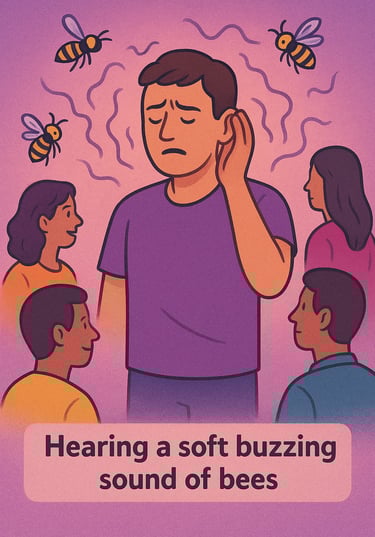
A few days later, as he sat in front of his computer editing audio for background music, he heard a soft buzzing tone, almost like a distant fly or an electronic hum but no one else heard anything. He paused, adjusted his headphones, and shrugged it off.
Then on his way home from a late shift, he felt a tingling creep over his right arm and hand, a crawling, electric-shock-like sensation. It felt as if his skin were “waking up” from numbness. His wrist felt cold and then hot, briefly, like an internal wave of temperature change. He pulled over, startled, as a rush of unease washed over him.
At first, Rahul didn’t connect these episodes. They felt random and insignificant. Maybe stress. Maybe overwork. But then one night he was in the shower, and suddenly the water felt icy on his left leg, though the temperature was unchanged. At the same time, he felt a spinning dizziness and a sense of disorientation in his head. For a moment, he felt as though he were drifting and losing balance, though his body stood still.
That night, he couldn’t sleep. He was anxious, unnerved, and curious. He went online and studied descriptions of “auras” and sensory seizures. The more he read, the more he realized: these episodes matched what some people call “focal sensory seizures.”
After months of keeping notes, drawing a “symptom diary,” and bringing his experiences to a neurologist, Rahul underwent an EEG and an MRI. The results pointed to focal epilepsy: electrical discharges in parts of his brain associated with sensory processing. Now he knew he wasn’t imagining things, and it wasn’t just stress.
With anti-seizure medication, small lifestyle changes (regular sleep, managing stress, avoiding known triggers), and a growing support network among friends who understood, Rahul began to feel in control again. He accepted that his brain sometimes “glitches” but that didn’t define him. He kept designing, kept dreaming, kept moving forward.
Rahul’s journey shows how focal sensory seizures are often subtle, easily overlooked but real, and manageable.
Focal Sensory Seizures: Understanding the Experience
Focal sensory seizures (also called focal sensory auras) begin in a specific area of the brain and create unusual sensations like tingling, heat, dizziness, odd head feelings, sounds, smells, or other sensory experiences. These sensations feel completely real to the person experiencing them, even though they are generated by the brain rather than the outside world.
They are considered “elementary” sensory symptoms, meaning they involve simple, basic sensory perceptions. Focal sensory seizures may not involve any outward motor signs (no jerking, no loss of consciousness) and may go entirely unnoticed or misinterpreted, even by the person experiencing them.
Because they’re subjective, felt rather than seen, these seizures are sometimes grouped under the term aura, which many people understand as a “warning” before a larger seizure. But an aura is itself a seizure and for some, it remains the only seizure they ever have. For some, this may be the first phase of a seizure that spreads and evolves into a focal motor seizure, a focal impaired awareness seizure, or a focal to bilateral tonic–clonic seizure.
If the sensory symptom is not present at the very start of the seizure, it is not used to classify the seizure type. Instead, it becomes a descriptor added after the seizure is classified based on its initial onset feature.
Important:
Focal sensory seizures are one type of epileptic aura. An aura is a subjective experience (sensory, emotional, autonomic, or cognitive) that represents the initial seizure activity in the brain. An aura may occur by itself or act as a warning sign that a larger seizure may follow.
Types of Focal Sensory Seizures (Elementary Sensory Symptoms)
1. Somatosensory Seizures
These involve abnormal sensations in the body:
Tingling, pins-and-needles
Electric shock–like feelings
Crawling or buzzing sensations
Numbness or “loss of feeling”
Heat or cold sensations
Pain (rare but possible)
These sensations often affect the face, fingers, hand, or one side of the body and may follow a “march” pattern (Jacksonian march) as the abnormal activity spreads along the sensory cortex.
2. Visual Seizures
These originate from the occipital lobe and may include:
Flashes of light
Colored spots or bright shapes
Sparkles or visual static
Brief blindness or darkening
Seeing simple patterns
These are NOT complex images (those would be complex hallucinations and involve different brain regions).
3. Auditory Seizures
Sound-based sensations may include:
Ringing
Buzzing
Humming
Simple tones
Sudden amplification or muffling of real sounds
Voices or complex sounds do not belong to this type.
4. Olfactory Seizures (Uncinate Fits)
These produce simple smells that others do not detect:
Burning
Smoke
Gasoline
Chemical smells
Rotten or metallic odors
They typically arise from the mesial temporal or orbitofrontal region.
5. Gustatory Seizures
These involve:
Sudden metallic taste
Bitter or sour flavor
Sweet taste
Chemical taste
Water “tasting wrong”
These can occur alone or with other sensory auras.
6. Focal Sensory Vestibular Seizure
A seizure that creates dizzy or spinning sensations, as if the room is tilting or rotating. People describe them as follows:
· Sudden dizziness, tilting, or spinning feelings (like brief vertigo).
· A sense that the body or environment is rotating or shifting.
These experiences come from seizure activity in brain regions that process balance, especially the parietal and temporal lobes or the temporo-parieto-occipital junction.
7. Focal Sensory Seizure with Hot–Cold Sensations
This seizure causes sudden shifts in body temperature sensations, such as a wave of heat followed by a chill, or the reverse. The body temperature doesn’t change temperature, but the brain’s sensory system misfires, creating this illusion.
8. Focal Sensory Seizure with Cephalic Sensation
A seizure that produces strange sensations in the head, such as light-headedness, pressure, or an abrupt, unexplainable head-feeling that doesn’t match normal dizziness or pain. Some people experience it as a brief “floating” or “empty” sensation inside the head.
Where These Seizures Come from in the Brain
Focal sensory seizures can originate from:
Primary sensory cortex (postcentral gyrus) → somatosensory
Occipital lobe → visual
Superior temporal gyrus or auditory cortex → auditory
Mesial temporal structures (amygdala, hippocampus) → olfactory
Insula/operculum → gustatory
Their clinical features closely reflect the topographic map of the sensory cortex (homunculus). That’s why hand, face, and distal limbs are so commonly involved.
Why Sensory Seizures Matter
An important clue
Sensory auras are more than just odd feelings: they are often the earliest, most telling sign of where in the brain the seizure originates. For example, tingling or numbness on one side of the body may point to the contralateral primary sensory cortex (post-central gyrus).
Similarly, bright flickers or flashes in one part of the visual field may indicate seizure activity in the occipital lobe’s primary visual cortex.
Properly identifying and describing the sensory symptoms, their type, location, and timing is often the first step neurologists use to localize the “seizure focus.” This is crucial, especially if the epilepsy might require more advanced treatments (e.g. surgery) later.
Why they are easy to miss
There’s no outward sign: no convulsions, no loss of consciousness, often nothing noticeable to bystanders.
The sensations are brief, often lasting only a few seconds.
They can be easily misinterpreted as stress, fatigue, migraine, dizziness, or simply “brain fog.”
Many people may not describe them because they don’t recognize them as seizures or because they fear being misunderstood.
That makes sensory seizures under-recognized, under-reported, and frequently misdiagnosed, leading to the assumption that “nothing is wrong,” causing delays in getting proper treatment.
What Causes Focal Sensory Seizures
As with all focal seizures, a variety of factors can cause sensory seizures:
Structural abnormalities in the brain (scarring, lesions, cortical dysplasia, tumors, past injury or trauma)
Brain infections or inflammation
Stroke or reduced blood flow to a part of the brain
Metabolic issues or imbalances
Genetic predispositions or inherited epilepsy syndromes
In most cases, no clear cause is identified (idiopathic)
Because the onset is localized, and because the sensory cortex is often involved, sensory seizures provide critical clues for diagnosis, especially when paired with neuroimaging (MRI) and electroencephalography (EEG) to confirm abnormal brain activity.
Awareness During Focal Sensory Seizures
Most people stay fully aware and can talk and respond normally. However, the sensations may be:
Confusing
Unsettling
Distracting
Hard to describe
Easy to mistake for migraines, panic, neuropathy, or sensory disorders
If the seizure spreads, it may evolve into:
A focal motor seizure
A focal impaired-awareness seizure
A bilateral tonic-clonic seizure
Diagnosis: How Doctors Determine It’s a Sensory Seizure
Making the right diagnosis involves multiple steps:
Clinical history & detailed description: When people like Rahul describe what they feel describing the exact sensation (tingling, buzzing, flash of light), how long it lasts, whether it repeats, whether there are triggering factors, that helps neurologists narrow down possible seizure types.
EEG (electroencephalogram): This records electrical activity in the brain. In many cases of sensory seizures, EEG shows abnormal discharges corresponding to the symptoms, although sometimes the EEG may appear normal (especially if the discharge is very focal or brief)
Neuroimaging (MRI, sometimes PET or SPECT): To look for structural abnormalities like scarring, lesions, malformations, tumors, or other causes that may underlie the focal seizures.
In some cases, when surface EEG and MRI are not conclusive, more advanced investigations (long-term video-EEG monitoring, intracranial EEG, functional imaging) may be considered especially if surgery is being considered.
Managing Focal Sensory Seizures
The good news is that many people with sensory seizures respond well to treatment. According to standard epilepsy care guidelines:
Anti-seizure (anti-epilepsy) medications are often the first line of treatment. They help reduce or prevent further seizures.
In addition, lifestyle and safety measures are essential, for example, establishing stable routines (sleep, stress, diet), avoiding known triggers, tracking symptoms and seizure patterns, and ensuring a supportive environment.
For some individuals, particularly those whose seizures are resistant to medications or who have a clearly defined structural focus, other options may be considered: nerve stimulation, diet therapy, or in some cases surgery.
Because sensory seizures can be subtle and easily missed, education, awareness, and self-monitoring become just as important as medication.
Living with Focal Sensory Seizures: A Message of Hope
When I first heard Rahul’s story, I realized how invisible and misunderstood sensory seizures can be. No convulsions. No dramatic collapse. Just flickers of light, buzzing sounds, shivers, tingles, dizziness, experiences that are easy to dismiss.
But for someone living them, they are real. Confusing. Frightening. Disruptive.
Yet, as Rahul’s journey shows, sensory seizures don’t have to define you. With understanding, support, proper treatment, and self-compassion, you can reclaim stability and creativity, routine, purpose.
You don’t have to wait for a grand convulsion to realize that something’s going on. If you feel something strange: light flashes, odd smells, buzzing sounds, a weird tingling, listen to your body. Record it. Talk to a neurologist. Describe it in detail. You might be experiencing a sensory seizure and that knowledge could change everything.
Sensory seizures may be subtle, but they are real. And with caring professionals, science, and community, they can be managed, giving people like Rahul the chance to keep living, creating, and dreaming.
Conditions Often Mistaken for Focal Sensory Seizures
Migraine aura (usually slower buildup, lasts longer, may move across the visual field)
Peripheral neuropathy
Transient ischemic attack (TIA)
Anxiety/panic sensations
Radiculopathy
Functional neurological symptoms
A detailed history, EEG findings, and correlation with brain regions help distinguish these.
Key Takeaways
Focal sensory seizures involve simple, brief, real-feeling sensations produced by abnormal brain activity.
Awareness is usually preserved.
They can remain isolated events or evolve into more noticeable seizure types.
Accurate diagnosis helps validate the patient’s experience and guide treatment.
Stories like Rahul’s show how confusing these seizures can be and how relieving it is to finally understand what’s happening.
Because these sensations are subjective, they often go unnoticed by others which can lead to confusion, misdiagnosis, or dismissal. Many people with sensory seizures may not realize that what they’re experiencing is a form of epilepsy. Choose knowledge:
Further Reading: