Understanding Temporal Lobe Seizures: Meet Liam
Temporal lobe seizures often do not look dramatic. They may begin with a strange sense of déjà vu, a rising feeling in the stomach, or a sudden wave of fear. Then comes a pause, a blank stare, repetitive movements of the mouth or hands, and afterward a period of confusion. Because these episodes can resemble daydreaming or anxiety, they are frequently misunderstood. This article explains what temporal lobe seizures are, how they feel, how they are diagnosed, and how they are treated. It also tells the story of Liam, a young man whose experience reflects what many people with temporal lobe epilepsy go through.
Dr. Clotilda Chinyanya
2/1/20265 min read


Liam’s Story: The Minute That Steals the Moment
Liam was nineteen when the first episode happened in a way he could not ignore. He was studying in a café before class. Music played softly in his ears. The room felt ordinary until it suddenly did not. The light seemed sharper. The sounds felt closer. A powerful wave of familiarity washed over him, as if he had already lived this exact second before. Then his stomach lifted upward, like an elevator rising from his abdomen to his throat. His heart raced. Fear appeared without cause. He tried to focus. He reached for his phone. But his hand slowed. His thoughts thinned. The world narrowed.
To others, Liam simply stopped. He stared at nothing. His lips moved slightly. He swallowed repeatedly. His fingers rubbed the edge of his sleeve in small, automatic motions.
Inside, he could hear fragments of sound but could not organize them. He was present and not present at the same time. After about a minute, it ended. He blinked. The café returned to normal. But he felt exhausted and confused. The conversation around him seemed to have jumped forward without him. He could not remember exactly what had happened.
Over the next few weeks, similar episodes followed. Sometimes they began with the same rising sensation. Sometimes with a sudden emotional surge. Once, while crossing a street, he paused mid step and stared while his hand picked repeatedly at his backpack strap. A stranger guided him safely to the curb.
At dinner one evening, his mother noticed him freeze, chew slowly without food in his mouth, and stare blankly. When he returned to awareness, he felt embarrassed and foggy. She looked frightened.
Eventually, Liam described his experience to a clinician:
“I get this strange warning, like déjà vu and a rising feeling in my stomach. Then I lose time.”
That description was crucial. It pointed toward temporal lobe seizures.
What Are Temporal Lobe Seizures?
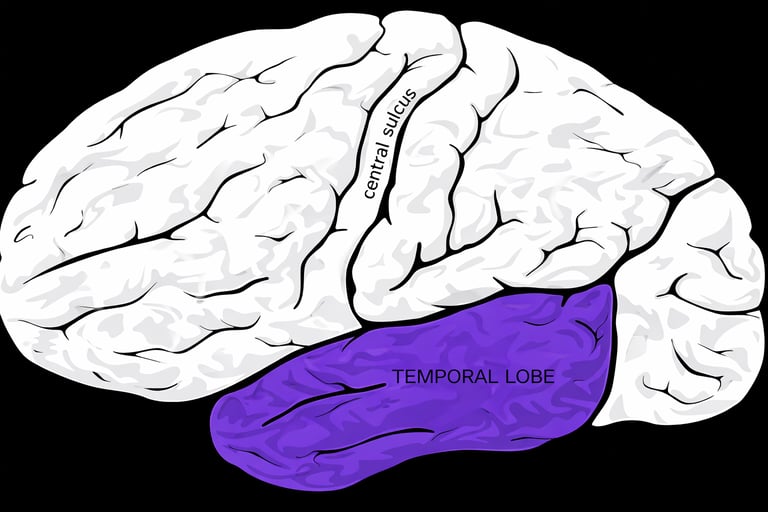
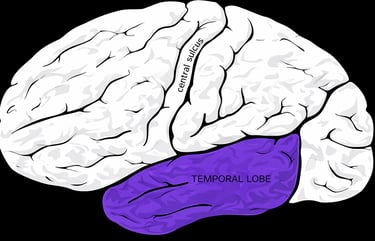
Temporal lobe seizures are focal seizures, meaning they begin in one area of the brain, specifically one of the temporal lobes1,2. The temporal lobes sit behind the temples. See image below:
The temporal lobes play key roles in:
· Memory
· Emotion
· Language
· Interpreting sound.
Because of these functions, seizures in this region often produce emotional, memory related, or sensory experiences rather than dramatic convulsions. Temporal lobe epilepsy is the most common form of focal epilepsy in both adults and children1,2,3. Approximately sixty percent of people with focal epilepsy have temporal lobe involvement1.
Auras: The First Clue
Many people with temporal lobe seizures experience an aura. An aura is actually a focal aware seizure. The person is awake and conscious, but abnormal electrical activity has already begun1,2.
Common temporal lobe auras include:
• Déjà vu or jamais vu
• A sudden surge of fear, anxiety, or joy
• A rising epigastric sensation in the stomach
• Unusual smells or tastes
• Auditory sensations such as buzzing or ringing, especially in lateral temporal seizures1,2,3.
Liam’s rising stomach sensation and intense déjà vu are classic examples of a mesial temporal aura1.
Focal Impaired Awareness Seizures
After the aura, awareness may become impaired. These seizures were previously called complex partial seizures.
During this phase, a person may:
• Stare blankly
• Stop responding
• Smack lips or chew
• Swallow repeatedly
• Pick at clothing or fidget
• Speak incoherently
• Exhibit brief language difficulty
These episodes usually last between thirty seconds and two minutes1,2.
Afterward, confusion, sleepiness, or difficulty speaking may occur. This recovery period is known as the postictal phase1,2,3.
Unlike absence seizures, temporal lobe seizures are often longer and are followed by more pronounced confusion1.
Mesial Versus Lateral Temporal Seizures
Temporal lobe epilepsy is not a single uniform condition. It includes different anatomical subtypes5.
Mesial Temporal Lobe Epilepsy
Mesial temporal lobe epilepsy involves inner structures such as the hippocampus and amygdala. It is often associated with hippocampal sclerosis, or scarring1,5.
Typical features include:
• Rising epigastric sensation
• Fear or emotional shifts
• Déjà vu
• Gradual progression to impaired awareness
• Oroalimentary automatisms
Seizures often last longer than sixty seconds and recovery may be slow5.
Lateral Temporal Lobe Epilepsy
Lateral temporal seizures arise in the outer temporal cortex.
They more commonly begin with:
• Auditory hallucinations or illusions
• Vertigo like sensations
• Earlier loss of awareness
• Shorter duration
They are also more likely to progress into bilateral tonic clonic seizures than purely mesial seizures1,5.
Causes and Risk Factors
Temporal lobe epilepsy may result from:
• Hippocampal sclerosis
• Traumatic brain injury
• Brain infections such as encephalitis or meningitis
• Brain tumors
• Stroke
• Developmental malformations
• Prolonged febrile seizures in childhood1,2,3.
Two thirds of people with temporal lobe epilepsy report a history of febrile seizures, although most children with febrile seizures do not develop epilepsy1.
In some cases, no clear structural cause is identified.
The Network Concept
Modern research has moved beyond the idea of a single seizure focus. Advanced intracranial monitoring techniques such as stereoelectroencephalography show that many temporal lobe seizures arise from epileptogenic networks rather than isolated points5.
These networks may involve mesial structures, lateral cortex, insula, frontal cortex, or even thalamic regions. When epileptogenic zones extend beyond the temporal lobe, this is referred to as temporal plus epilepsy5. Understanding these networks is critical when considering surgery or neuromodulation.
Diagnosis
Diagnosis begins with a detailed history. Witness accounts are often essential because individuals may not recall impaired awareness2.
Evaluation typically includes:
• Electroencephalogram, including video EEG monitoring
• Magnetic resonance imaging using epilepsy specific protocols
• Neuropsychological testing in surgical candidates1,2,3.
In drug resistant cases, advanced epilepsy centers may perform invasive monitoring to precisely map epileptogenic networks5.
Treatment
Anti Seizure Medications: Anti seizure medications are first line treatment. About half to seventy percent of patients achieve good seizure control with medication1,3.
Surgery: If seizures persist despite appropriate medication trials, surgery may be considered. Anterior temporal lobectomy is one of the most studied epilepsy surgeries and can lead to seizure freedom in many well selected patients3,5.
Neuromodulation: For individuals who are not surgical candidates or whose seizures arise from broader networks, neuromodulation therapies such as vagus nerve stimulation, responsive neurostimulation, or deep brain stimulation may reduce seizure frequency2,3,5.
Treatment decisions are individualized and should be guided by a comprehensive epilepsy team.
Living With Temporal Lobe Epilepsy
Liam eventually began treatment with anti-seizure medication. He learned to recognize his aura and move to a safe place. His family learned seizure first aid. He began tracking sleep and stress patterns. Over time, he regained confidence.
Temporal lobe seizures are not a personal weakness. They are the result of abnormal electrical activity in networks that govern memory, emotion, and perception. With appropriate diagnosis and management, many people achieve meaningful seizure control and improved quality of life1,2,3.
If you or someone you love experiences episodes of unexplained déjà vu, sudden fear, blank staring, repetitive mouth movements, or post episode confusion, seek medical evaluation. The story matters.
References
International League Against Epilepsy. “Temporal Lobe Seizures Overview.” https://www.epilepsydiagnosis.org/seizure/temporal-overview.html
Cleveland Clinic. “Temporal Lobe Seizures.” https://my.clevelandclinic.org/health/diseases/17778-temporal-lobe-seizures
Massachusetts General Hospital. “Temporal Lobe Epilepsy: Symptoms, Diagnosis and Treatment.” https://www.massgeneral.org/neurology/treatments-and-services/epilepsy/temporal-lobe-epilepsy
Epilepsy Foundation. “Temporal Lobe Epilepsy.” https://www.epilepsy.com/what-is-epilepsy/syndromes/temporal-lobe-epilepsy
Bartolomei F, et al. “Temporal Lobe Epilepsies: Epileptogenic Networks and SEEG-Based Subtypes.” https://doi.org/10.1016/j.neurol.2025.03.004
Choose Knowledge: